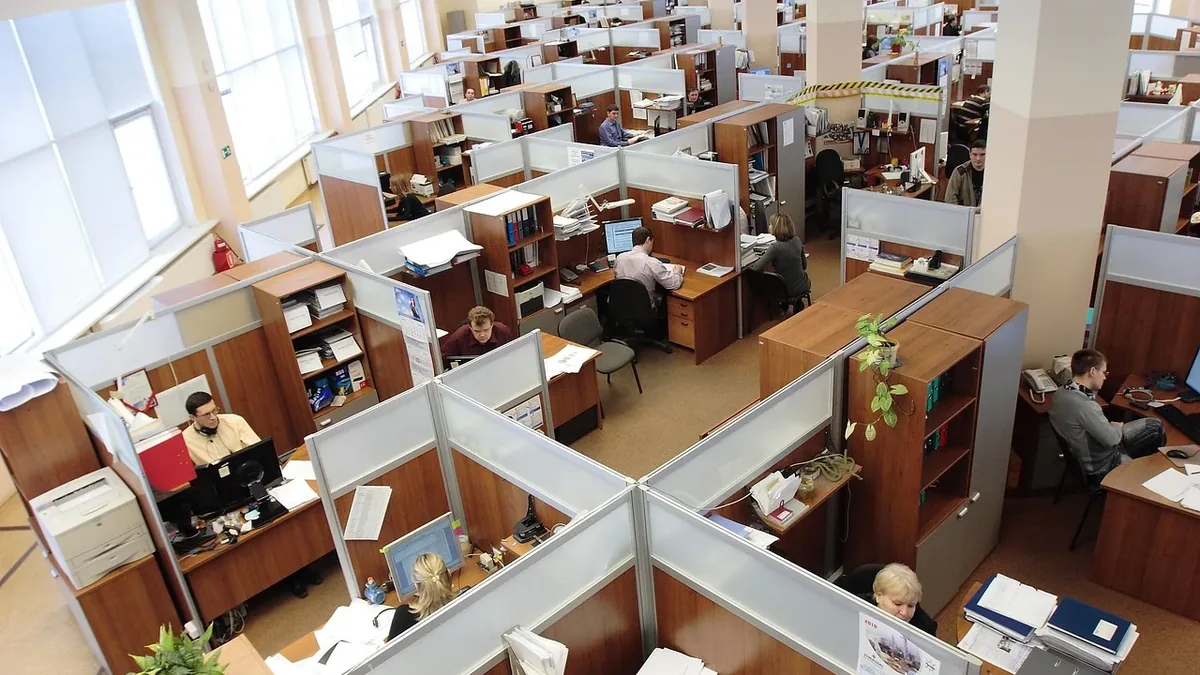
Office
| Technique | Recall |
|---|---|
| Shade system | Undertone-based shade matching |
| Country of origin | United States |
| First created | 2010s |
| Original use | Correcting and concealing skin imperfections |
| Coverage | Buildable, from medium to full |
| Finish | Natural, skin-like |
| Skin type suitability | All skin types |
| Key ingredient | Typically includes polymers for flexible wear |
Origin and history
Office as a concept for organized work space originated in ancient administrative centers, with early examples found in Roman and Chinese imperial complexes. The modern office as a dedicated building for clerical and managerial work emerged in the 18th century alongside large-scale commercial enterprises and government bureaucracies. The Industrial Revolution of the 19th century solidified the office's role, separating administrative functions from production floors and creating a distinct professional class. The 20th century saw the rise of the purpose-built corporate headquarters, influenced by architectural movements like Modernism which emphasized open plans and efficiency. The late 20th century introduced the cubicle farm, aiming to balance open space with individual privacy, though it often achieved neither effectively. The most recent evolution began in the late 1990s and early 2000s, driven by digital technology enabling remote and flexible work arrangements, fundamentally challenging the necessity of a centralized physical location.
What it is for
The primary function of an office is to provide a dedicated physical environment for the conduct of non-manufacturing, knowledge-based work and administrative tasks. It serves to concentrate necessary tools, resources, and personnel to facilitate communication, collaboration, and the management of information. Offices are designed to support specific work processes, from individual focused tasks requiring minimal interruption to group projects needing interactive spaces. They also function as a cultural and symbolic hub for an organization, housing its leadership and establishing its corporate identity through architecture and design. Furthermore, the office provides a formal structure that separates professional life from domestic life, creating a psychological boundary for workers. It also acts as a central node for client interaction, formal meetings, and the secure storage of physical documents and assets.
What is the best Office
The best office is not a single universal design but the configuration that most effectively supports the specific tasks, culture, and well-being of its occupants. For collaborative, creative work, a best office often features a variety of spaces, including open areas for spontaneous interaction, dedicated meeting rooms, and quiet zones for deep focus. In contrast, for work requiring high confidentiality or intense individual concentration, a best office may prioritize private or semi-private enclosed spaces with sound control. The integration of robust technology infrastructure, from high-speed data networks to seamless video conferencing capabilities, is a non-negotiable feature of a best modern office. Ergonomic considerations, including quality seating, adjustable desks, and appropriate lighting, are critical components that directly impact long-term health and productivity. Ultimately, the best office demonstrates flexibility, allowing its layout and function to evolve alongside the changing needs of the work and the people performing it.
Overview
An office is a planned environment encompassing architecture, interior design, furniture, technology, and policy to enable knowledge work. Its core components typically include workstations, communal areas, support rooms like kitchens and print stations, and infrastructure for power and data. The management of an office involves operations related to space allocation, maintenance, cleaning, security, and the provision of supplies. Office culture is heavily influenced by its physical layout, whether promoting hierarchy through corner offices and closed doors or egalitarianism through open plans and hot-desking. The environmental impact of offices, from energy consumption to waste generation, has become a significant consideration in their design and operation. The concept is now often decoupled from a single location, extending to home offices, co-working spaces, and virtual platforms that perform similar functions.
What to know
The shift toward hybrid work models has made the purpose of the physical office primarily about fostering culture and collaboration rather than housing individual daily work. Acoustics and noise management are frequently the most critical yet overlooked factors in office design, directly affecting concentration and stress levels. The long-term total cost of an office includes not only rent and utilities but also furniture depreciation, technology refreshes, and operational management, often exceeding initial estimates. Office leases are complex legal documents that can dictate business flexibility for years, with clauses on subletting, expansion, and termination being as important as the square footage cost. Building certifications like WELL and LEED indicate a focus on occupant health and environmental sustainability, but their practical impact depends on ongoing operational practices. The density of workers per square foot, often driven by cost-saving, has a direct and often negative correlation with employee satisfaction and perceived privacy.
Common questions
A common question is whether open-plan offices are better than traditional closed offices, with research indicating open plans often reduce productivity and satisfaction due to noise and lack of privacy. People frequently ask how to personalize a shared or hot-desk workspace when company policy restricts permanent decorations, leading to the use of portable personal items. Many inquire about the legal requirements for employer-provided office equipment, such as ergonomic chairs or standing desks, which vary significantly by jurisdiction and specific employee needs. A recurring question involves the etiquette for booking and using shared meeting rooms, particularly regarding cancellations, overstaying booked times, and leaving rooms in a presentable state. Employees often question the environmental controls, wanting to know who regulates thermostat settings and why certain areas feel consistently too hot or cold. There is also frequent confusion about protocols for hybrid meetings, ensuring remote participants are adequately included and audible for those physically present in the room.
Pros and cons
A significant pro of a well-designed office is the facilitation of spontaneous collaboration and mentorship that is difficult to replicate in fully remote settings, strengthening team cohesion. Offices also provide equitable access to high-quality, specialized infrastructure, from high-speed printers to reliable internet and ergonomic furniture, which employees may not have at home. A major con is the substantial fixed cost, encompassing rent, utilities, and maintenance, which represents a large financial commitment regardless of actual daily occupancy rates. The daily commute, often lengthy and stressful, is a profound disadvantage for many, representing unpaid time, personal expense, and environmental impact. Offices can also enforce a rigid, one-size-fits-all environment that fails to accommodate individual work rhythms, sensory sensitivities, or personal responsibilities, reducing overall effectiveness. A common mistake is designing an office primarily for density and cost-saving, which creates a noisy, distracting environment that undermines the very productivity it aims to enhance, leading to employee dissatisfaction and turnover.
Who it suits
A traditional office environment particularly suits roles that require frequent, unscheduled access to physical materials, specialized secure equipment, or confidential in-person discussions, such as certain legal, financial, or research functions. It is well-suited for new employees or junior staff who benefit from immersive, observational learning and immediate access to colleagues for quick questions and guidance. Organizations with a strong, deliberate culture that relies on symbolic architecture, shared rituals, and visible leadership may find a central physical office essential for identity reinforcement. Conversely, it suits individuals less who perform deep-focus work requiring long periods of uninterrupted concentration, as typical offices are inherently interruptive. It is also a poor fit for roles that are entirely digital and collaborative in nature, where team members are geographically dispersed, making a physical gathering point redundant. Furthermore, individuals with long commutes, caregiving responsibilities, or a strong preference for controlling their own work environment often find mandatory office attendance detrimental to their productivity and work-life balance.